
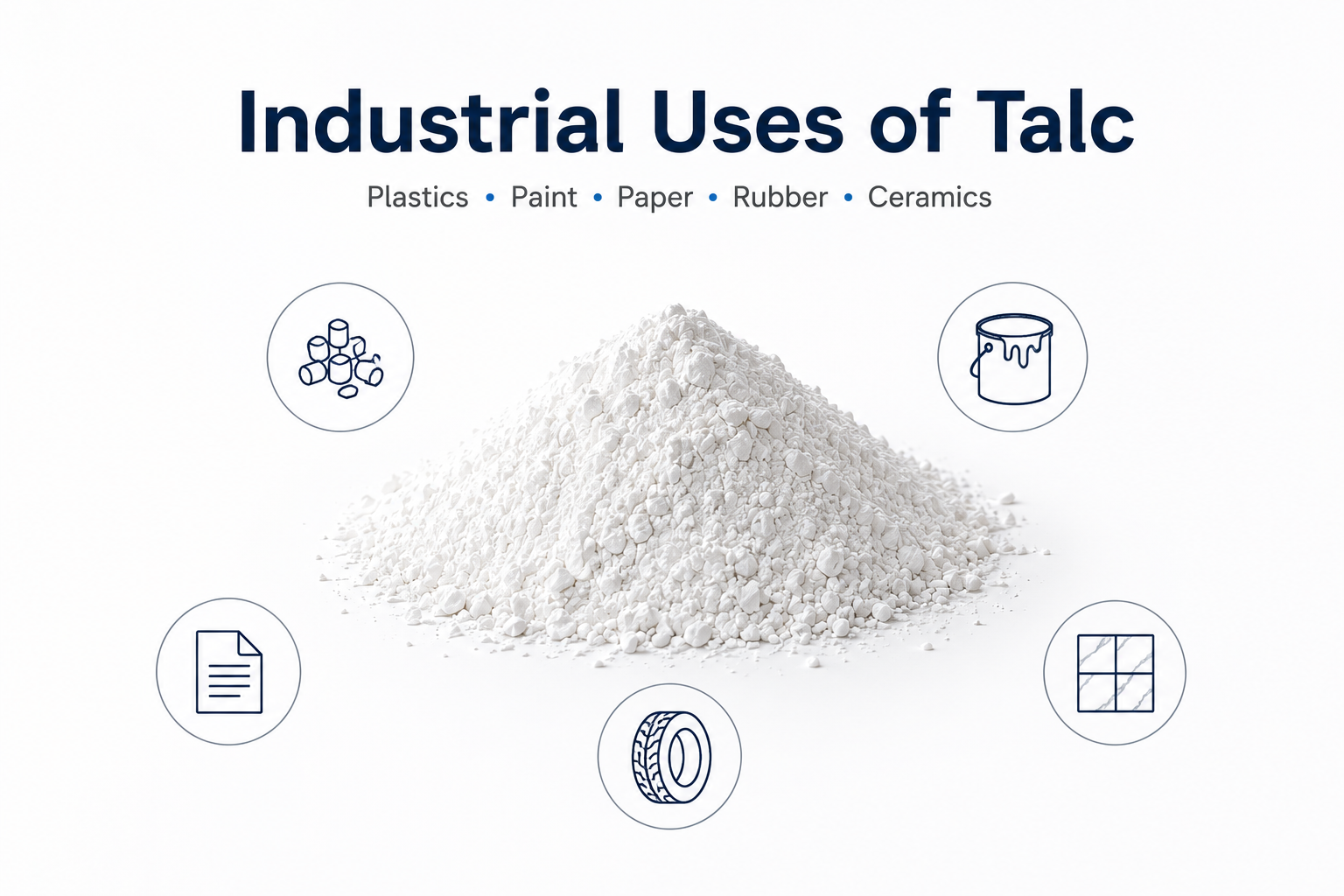
So, what is talc used for? In short, talc is a soft, platy mineral used as a functional filler and processing aid across plastics, paint, paper, rubber, ceramics, and construction. It’s best known to most people through cosmetic products, but that’s only a small part of the story. This article focuses specifically on how talc is used across industrial manufacturing, and why so many different sectors rely on it.Talc is extracted from natural deposits of metamorphic rock and processed into different grades and particle sizes for industrial use. For more detail on how talc is mined and processed, see our guide.
Talc in plastics
When people ask what is talc used for in manufacturing, plastics is usually the first and largest answer. One of the largest industrial talc applications is as a reinforcing filler in plastics, particularly polypropylene (PP), polyethylene (PE), and PVC. Adding talc to these resins improves stiffness, impact resistance, dimensional stability, and heat resistance, making the finished part more durable and better able to hold its shape under load or temperature change. It also gives the plastic a smoother surface finish and reduces surface defects, which matters in applications where appearance and consistency count. Because talc can partially replace resin in the formulation, it also reduces the amount of resin needed, which lowers material cost without compromising performance, which is a major reason it’s so widely used in automotive parts, packaging, and consumer plastic goods.
Talc in paint and coatings
In paints and coatings, talc acts as an extender and matting agent, helping to bulk out the formulation while contributing to the coating’s overall performance. It improves opacity, helps keep pigments evenly suspended, and adds weather resistance to the finished coating. Talc’s platy, or lamellar, structure is particularly useful here: the flat, plate-like particles overlap within the coating film, giving it better barrier properties that help protect the underlying surface and extend the coating’s lifespan. Because talc improves opacity and coverage, it also reduces the amount of more expensive pigment needed to achieve the same result, making it a cost-efficient addition to many paint and coating formulations.
Talc in paper manufacturing
Talc powder used for papermaking serves two main roles: as a filler and as a coating agent. As a filler, talc improves the brightness, opacity, and printability of the finished paper, giving it a smoother, more uniform surface for printing. As a coating agent, it contributes to a similar improvement in finish and print quality. Talc also plays an important behind-the-scenes role during pulping: it acts as a pitch control agent, absorbing organic resin impurities released from wood pulp. Without this, those impurities can build up as sticky deposits on papermaking machinery, slowing production and increasing maintenance needs, so talc’s contribution here is as much about process efficiency as it is about the final product.
Talc in rubber
In rubber compounding, talc functions as both a processing aid and a reinforcing filler. It improves tensile strength and tear resistance in the finished rubber product, which is especially important in parts that need to withstand mechanical stress over time. During manufacturing, talc reduces stickiness in the rubber compound and improves mold release, meaning parts separate more cleanly from molds, which speeds up production and reduces downtime on the factory floor. These properties make talc common in automotive and industrial rubber goods such as hoses, seals, and gaskets, where consistent quality and efficient production both matter.
Talc in ceramics and construction
Talc has a couple of important, if smaller-scale, industrial applications in ceramics and construction. In ceramics, talc acts as a flux, lowering the firing temperature needed to produce tiles, sanitary ware, and tableware, while also improving plasticity and vitrification during the firing process. In construction, talc is added to asphalt roofing materials to improve their weather resistance and durability over the life of the roof. Compared with plastics, paint, paper, and rubber, these are secondary applications, but they’re still a good illustration of how versatile talc powder used for industrial purposes can be.
A quick summary: what is talc used for across industries?
|
Industry |
Role talc plays | Key benefit |
| Plastics (PP, PE, PVC) | Reinforcing filler |
Improves stiffness, impact resistance, dimensional stability; reduces resin cost |
|
Paint & coatings |
Extender / matting agent | Improves opacity, suspension, weather resistance; reduces pigment needed |
| Paper | Filler & pitch control agent |
Improves brightness, opacity, printability; absorbs resin impurities during pulping |
|
Rubber |
Processing aid & reinforcing filler | Improves tensile strength, reduces stickiness during molding, aids mold release |
| Ceramics & tiles | Flux and plasticity aid |
Lowers firing temperature, improves plasticity, gives smooth surface finish |
|
Construction (roofing/asphalt) |
Filler / weather-resistance additive | Improves durability and weather resistance of roofing materials |
Why talc works so well as an industrial filler
Looking across all of these industries, the same handful of properties explain why talc keeps showing up in such different formulations. Talc is the softest known mineral, rated 1 on the Mohs hardness scale, which contributes to its smooth feel and makes it easy to process into a fine powder. It’s also chemically inert, meaning it doesn’t react with most acids, alkalis, or organic compounds, a property that makes it compatible with a very wide range of formulations without interfering with other ingredients. Its platy, lamellar particle structure is behind its ability to improve barrier properties in coatings and reinforce plastics and rubber effectively, since the flat particles align and overlap within a material. Finally, talc is naturally hydrophobic, meaning it repels water, which is especially useful in coatings and roofing applications that need to hold up against moisture and weather. Chemically, talc is a hydrous magnesium silicate, with the formula Mg₃Si₄O₁₀(OH)₂. Together, these core properties (softness, inertness, particle shape, and hydrophobicity) are why the same mineral can serve so many different industrial functions across plastics, paint, paper, rubber, ceramics, and construction.
For a closer look at the different types of talc powder available, see our full guide.
Looking for industrial-grade talc powder?
Narm Powder is an industrial talc powder supplier offering both white and grey talc for applications ranging from plastics and coatings to paper, rubber, ceramics, and construction. If you’d like full specifications or want to request a sample, visit our Talc product page.