
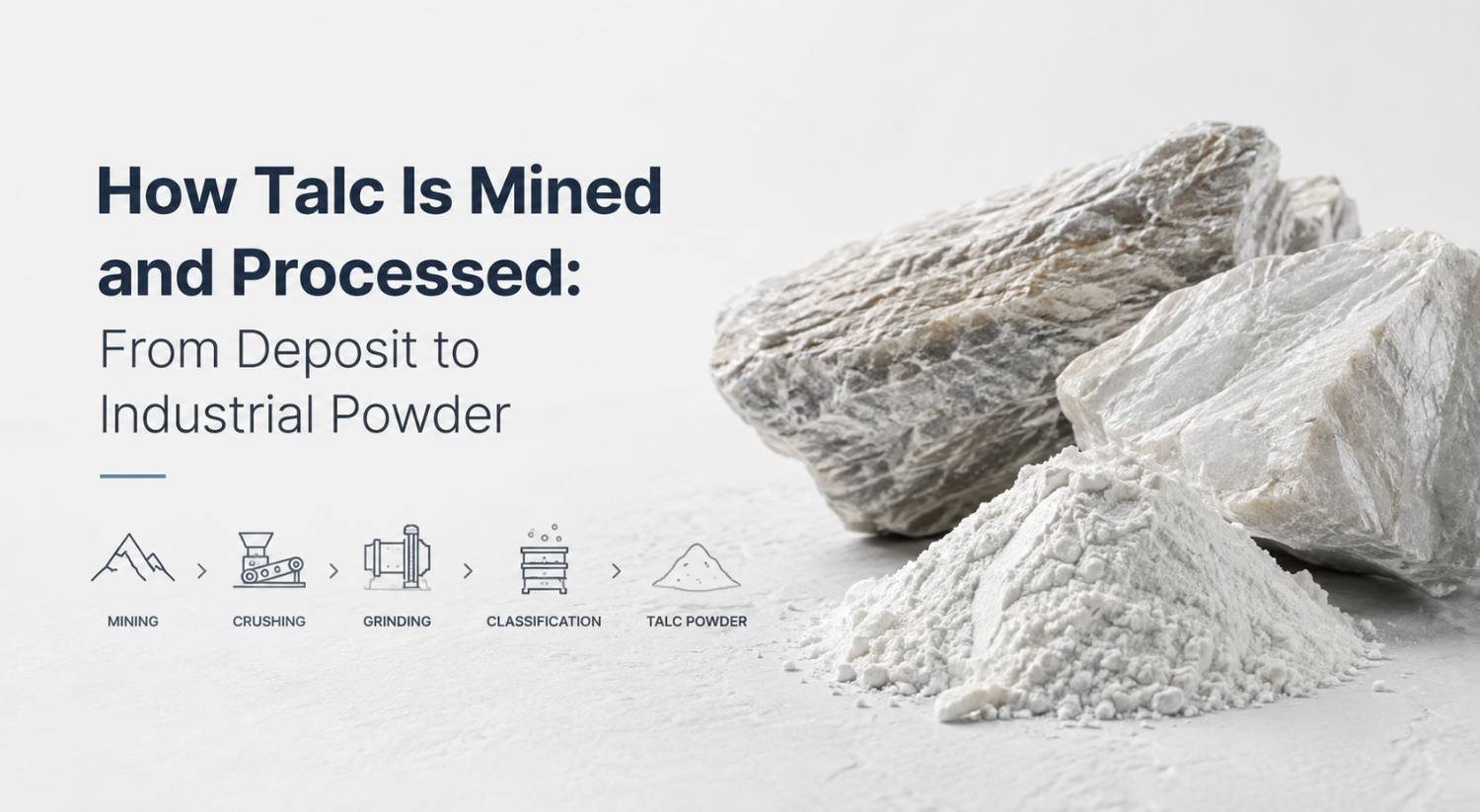
How talc is mined starts long before any machinery touches the rock. Talc is extracted from the ground through mining, usually open-pit and sometimes underground, and from there it goes through a sequence of purification and size-reduction steps before it becomes the fine industrial powder buyers actually use. This article walks through that journey step by step, from the first geological survey to the finished bag of powder. It doesn’t cover what talc is used for or the different grades available. Those are worth their own articles, and you’ll find them elsewhere in this series.
Exploration and deposit assessment
Before anyone mines anything, geologists have to find it first. Exploration teams identify talc-rich areas and estimate how much ore is there and what quality it is, using core drilling, trenching, and geochemical or geophysical surveys. This groundwork matters more than it might seem. Talc deposits are not all the same. They vary in color, texture, particle size, and impurity content from one site to the next, largely because of how talc is formed in the first place, and that variation is a big part of why no two deposits end up producing the same grade of finished powder. It’s also part of why understanding how talc is mined really has to start with understanding the deposit itself, not just the equipment used to extract it.
Extraction
Once a deposit has been assessed and confirmed, extraction begins, and this is really the heart of the talc mining process. Open-pit mining is the most common method used for talc, and it typically involves drilling and blasting to break the ore free from the surrounding rock. Underground mining is used in some regions instead, depending mostly on how deep the deposit sits below the surface. Either way, once the raw talc ore has been extracted, it’s transported to a processing facility, where the real transformation into industrial powder begins.
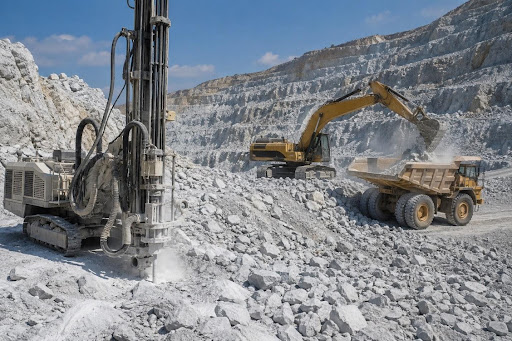
The full process at a glance
Talc processing follows a fairly consistent sequence across the industry, even though the specific equipment can vary by operation. The table below lays out each stage, what happens during it, and the equipment typically involved.
|
Stage |
What happens | Common equipment |
| Exploration | Core drilling, trenching, geochemical/geophysical surveys to identify deposit quality and volume |
Drilling rigs, survey equipment |
|
Extraction |
Open-pit (most common) or underground mining, using drilling and blasting to remove the ore | Excavators, drilling and blasting equipment |
| Sorting / beneficiation | Removes impurities (iron, chlorite, magnesite) via hand sorting, flotation, or magnetic/photoelectric separation |
Flotation cells, magnetic separators, sorting equipment |
|
Crushing |
Reduces raw ore to manageable fragments | Jaw crushers, hammer crushers, cone crushers |
| Grinding | Reduces crushed material to fine powder |
Ball mills, Raymond mills, jet mills for ultrafine grades |
|
Classification |
Separates particles by size to meet mesh/grade specifications | Air classifiers, spiral classifiers, cyclones |
| Drying and packaging | Removes residual moisture, final quality checks, packing for distribution |
Rotary dryers, packaging lines |
Removing impurities through beneficiation
Raw talc ore rarely comes out of the ground pure. It typically carries impurities like iron, chlorite, and magnesite, and these need to be removed before the powder can meet consistent quality standards. A few different techniques handle this, sometimes in combination: hand sorting, flotation, magnetic separation, and photoelectric sorting. Flotation deserves a special mention here, because it works so well specifically because of a quirk in talc’s chemistry. Talc is naturally hydrophobic, meaning it repels water, while most of the impurity minerals it’s found alongside are hydrophilic. That difference means talc floats to the surface during flotation while the impurities sink, making separation surprisingly efficient. This is also where grade differences start to take shape. The deposit’s mineral composition and the effectiveness of beneficiation influence the quality and characteristics of the finished talc powder. To understand how talc is classified into different grades and types, see our guide to types of talc powder.
Crushing, grinding, and classification
Once impurities have been reduced, the beneficiated ore moves into size reduction. Crushing comes first, breaking the material down into manageable fragments using jaw crushers, hammer crushers, or cone crushers. From there, grinding takes those fragments down to a fine powder. Standard grades typically go through ball mills or Raymond mills, while ultrafine or micronized grades need jet mills to hit the tighter particle sizes required. Talc happens to be the softest known mineral, sitting at just 1 on the Mohs hardness scale, and that softness is a big practical advantage here. It grinds easily and efficiently, which is one of the reasons talc has stayed such a cost-effective industrial filler over the years. Finally, air classification separates the ground material by particle size, which is how the industry ends up with all the different mesh grades used across various applications.
Drying, quality control, and packaging
After grinding and classification, the processed talc still needs to be dried to remove any residual moisture. Quality checks follow, typically covering particle size distribution, whiteness, and purity, before the material is packaged for distribution. Some deposits need an extra step here. Ore with organic impurities often requires calcination, a high-temperature treatment carried out in a rotary kiln, usually somewhere between 600 and 1200 degrees Celsius, to achieve uniform chemical and physical properties. Higher calcination temperatures generally push whiteness up further, and maximum whiteness after calcination can reach above 90 on the brightness scale. It’s a demanding step, but it’s also where a lot of the consistency buyers expect from a finished batch actually comes from.
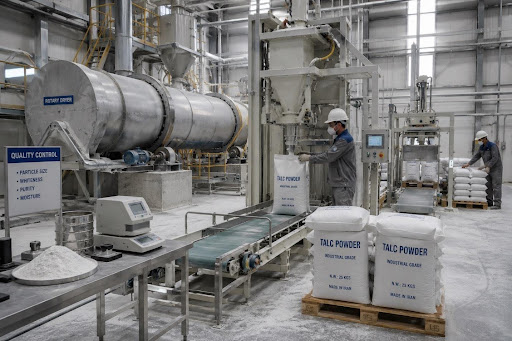
A controlled process from start to finish
Narm Powder produces industrial-grade talc powder through a controlled, quality-checked process, from sourcing to packaging. For product specifications or to request a sample, visit our industrial talc powder product page.