
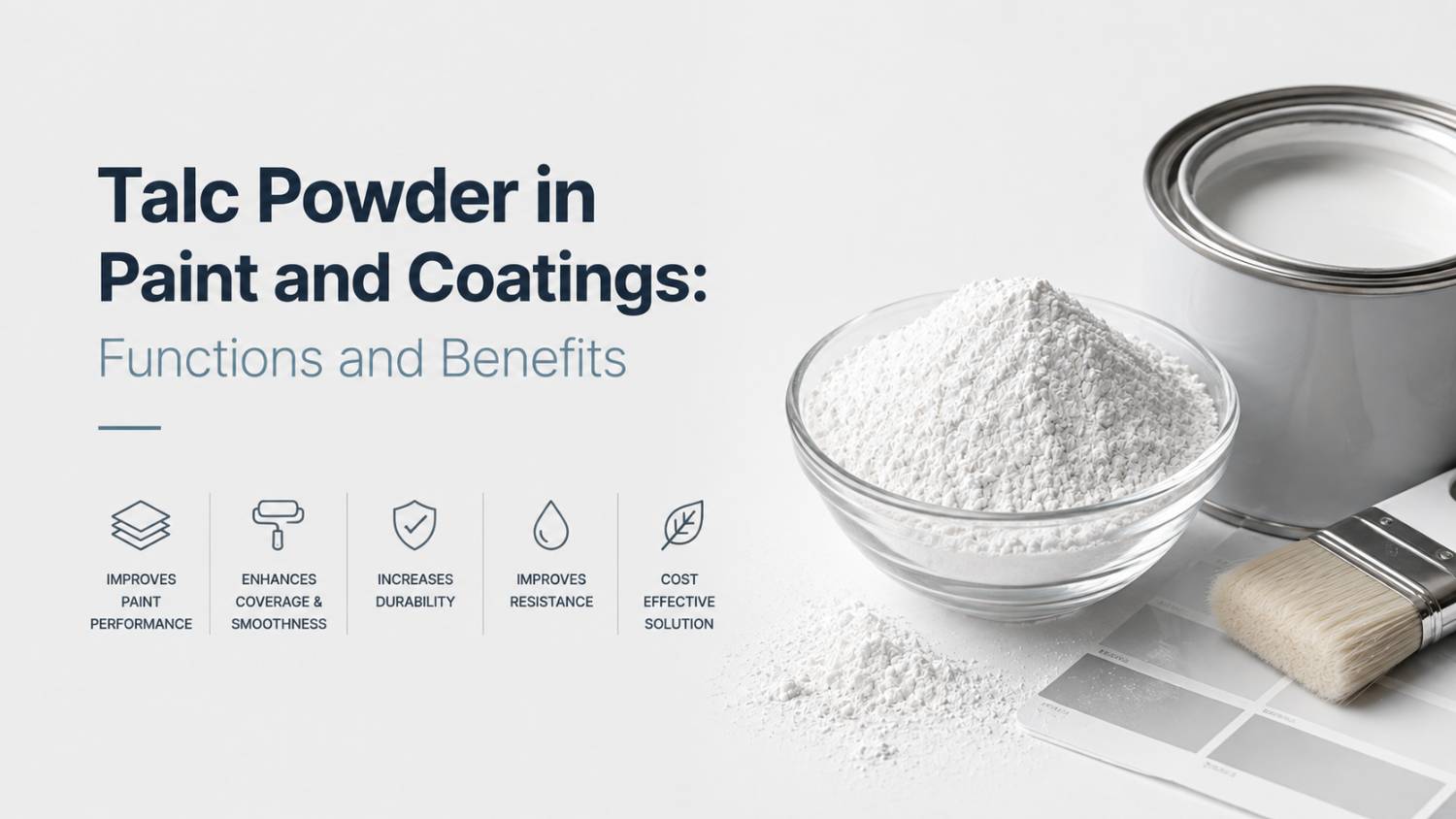
Talc is a multi-functional filler and extender used across water-based, solvent-based, and powder-coat paints and coatings. Talc for paint is valued specifically for its lamellar, flat, plate-like particle structure, which sets it apart from more rounded mineral fillers like calcium carbonate and gives it a broader functional role than a simple bulking agent. For formulators already working with TiO2 and other mineral fillers, talc for paint is less about replacing what’s already in the formulation and more about filling functional gaps that rounder particles can’t address as effectively. This article walks through what talc actually does in a paint formulation, why its particle shape matters, and how to think about grade selection for different coating types.
Key functions in paint formulations
Talc in paint contributes to several distinct functions at once, rather than serving just one role in the formulation, which is part of what makes it a useful default filler across such a wide range of coating types. The table below summarizes the main functions talc performs across paint and coatings applications.
|
Function |
What it does |
| TiO2 extender |
Improves the tinting strength and efficiency of titanium dioxide, reducing the amount of expensive prime pigment needed |
|
Anti-corrosion |
Lamellar (flat, plate-like) particle structure extends the diffusion path of corrosive substances, slowing water and corrosive agent penetration into the film |
| Matting agent |
Talc’s structure creates diffuse light reflection at the surface, contributing to matting effect and controlling gloss level |
|
Crack and sag resistance |
Platelets act as bridges between binder agglomerates, strengthening the film and reducing cracking and sagging |
| Suspension and viscosity control |
Helps disperse and suspend solids evenly, preventing settling in the can and improving application consistency |
|
Adhesion and durability |
Chemical inertness and lamellarity promote adhesion, improving overall paint durability and weather resistance |
Why talc’s particle shape matters in coatings
Talc’s defining advantage in coatings is its lamellar, flat, plate-like particle structure, and this single characteristic is really what gives it its multi-functional benefits, distinct from more rounded fillers. As a coating dries, the flat platelets tend to orient themselves parallel to the surface, and that orientation is the mechanism behind two of talc’s most valued properties. It extends the diffusion path that water and corrosive substances have to travel to penetrate the film, which is the basis of talc anti-corrosion coatings performance. It also allows the platelets to bridge between binder agglomerates as the film forms, strengthening it and directly improving crack and sag resistance. Both effects come from the same underlying particle geometry, which is part of why talc for paint tends to deliver several benefits simultaneously rather than trading one property off against another, and why formulators evaluating it don’t usually have to choose between corrosion protection and film strength.
Anti-corrosion and protective coatings
In anti-corrosion primers, talc improves corrosion resistance and paint adhesion by limiting the penetration of water and corrosive agents into the film, which in turn reduces corrosion, caulking, peeling, and blistering over the coating’s service life. This is particularly valuable in steel structure coatings, where talc can partially or completely replace other fillers while improving coating sedimentation, mechanical properties, and recoatability. It also contributes to weather resistance in outdoor paints by reducing oxygen and water transmission through the film, which helps protect the binder itself from UV degradation over time. Talc anti-corrosion coatings are especially common in industrial and infrastructure settings, where the cost of coating failure and subsequent maintenance is high enough that formulators tend to prioritize proven performance over cutting formulation cost. In marine coatings specifically, talc offers moisture resistance, abrasion resistance, and antifouling properties, protecting against corrosion and environmental degradation in one of the more demanding environments a coating can face. Powder coatings used on steel structures also benefit from talc, which acts as a flow modifier and texturizing agent, improving flow and leveling during application.
Architectural and decorative coatings

In interior and exterior decorative paints, talc acts as an extender that improves hiding power and boosts the efficiency of titanium dioxide, allowing formulators to reduce TiO2 usage while maintaining opacity, a meaningful consideration given how much TiO2 typically contributes to formulation cost. It improves brushability, gloss retention, and leveling properties, and enhances dry and wet hiding power, matting effect, crack resistance, and scrub resistance across a range of finishes. Coarser talc grades suit applications needing a rougher paint film, such as interior wall primers, while ultrafine grades are used to control gloss, consistency, and sag performance in semi-gloss finishes. In wood coatings, talc’s low hardness gives the paint film good sandability, allowing it to partially replace costlier zinc stearate sanding and matting agents. Talc’s refractive index is also similar to that of resin binders, which gives wood coatings a level of transparency that lets the substrate’s natural texture show through rather than being obscured by the filler, a property that’s particularly valued in clear or lightly tinted wood finishes.
Grade selection: color, particle size, and oil absorption
Color, particle size, and oil absorption are the main criteria formulators use when selecting talc powder for a specific paint or coating type. Fibrous or flake-structured talc grades tend to have higher oil absorption and better rheological properties, which is useful for controlling viscosity and application behavior in the finished product. Getting this selection right has a direct effect on how the paint applies and performs once cured, which is why grade choice deserves as much attention as the base resin or pigment selection when specifying talc for paint. For a more detailed comparison of particle sizes and industrial grades, see our guide to micronized talc powder and its industrial grades.
Industrial Talc for Paint and Coatings
Narm Powder supplies industrial-grade talc powder for paint and coatings applications, from anti-corrosion primers to decorative and wood finishes. For product specifications or to request a sample, visit our talc powder product page.
Talc is also used as a functional filler in polymer formulations, where particle structure and grade selection influence performance. Learn more in our guide to talc powder in plastics.