
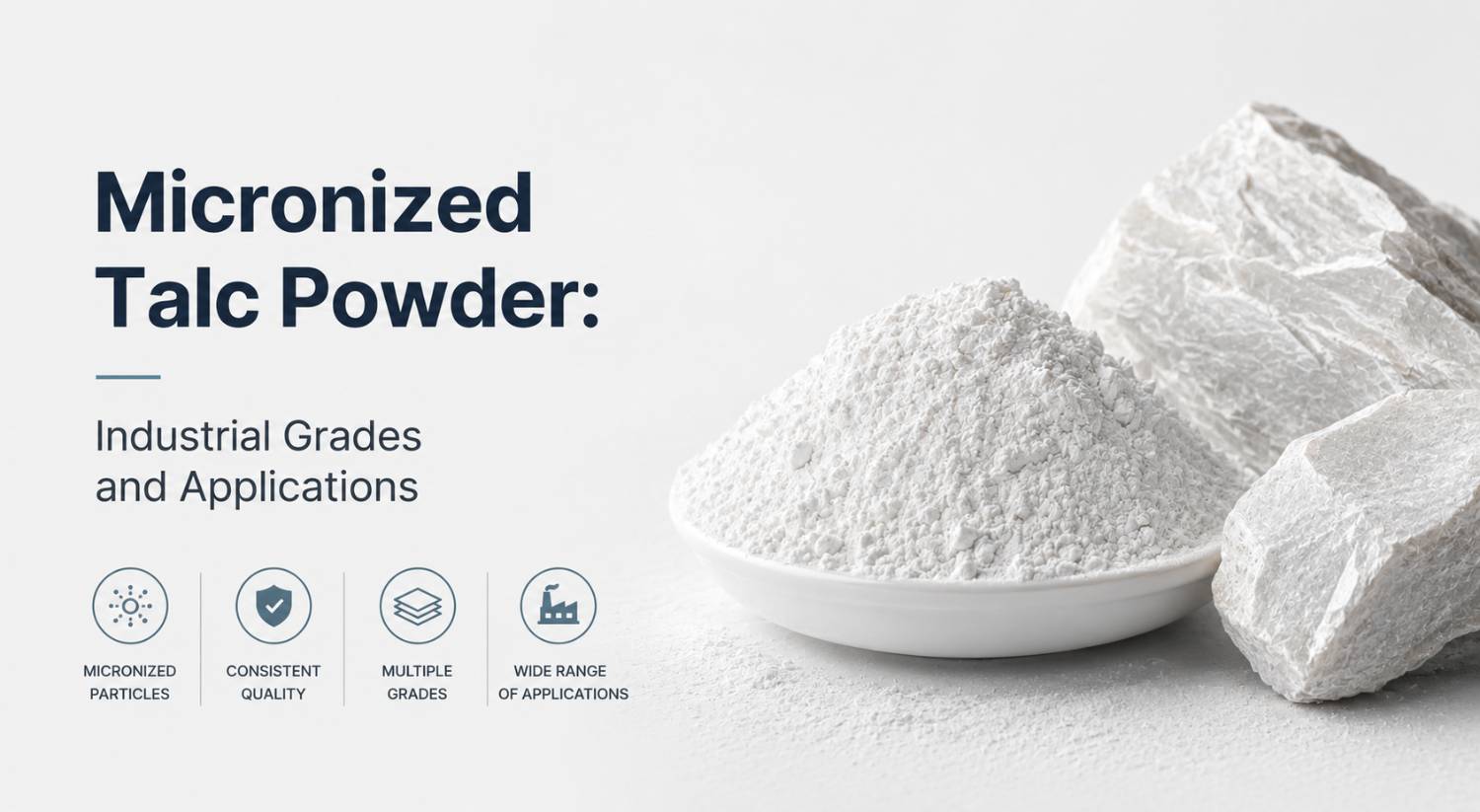
Micronized talc powder is talc that has been finely ground and classified to achieve a specific, controlled particle size distribution, offering improved mechanical strength, processability, and surface finish compared to standard-ground talc. For buyers and formulators, the key question isn’t whether to use talc at all, but which of the available industrial talc grades actually fits the application at hand, since the wrong grade can undercut performance even when the underlying mineral is perfectly suitable. This article focuses specifically on what “micronized” means in practice and why grade selection matters, rather than covering the mineral’s broader properties or how it’s mined, which are covered elsewhere. By the end, you should have a clearer sense of how talc mesh sizes map onto real-world performance across a handful of common industrial applications.
What makes talc ‘micronized’
Micronization takes standard ground talc a step further. It’s processed through fine grinding and air classification, and sometimes jet milling for ultrafine grades, to achieve tighter, smaller particle size distributions than standard grinding alone can produce. This extra processing step enhances several key properties: more tightly controlled particle size, improved brightness, high lamellarity, meaning a flat, plate-like particle structure, excellent softness, and superior dispersion once the talc is incorporated into a formulation. Because talc has a Mohs hardness of just 1, among the softest minerals known, it grinds efficiently down to very fine particle sizes, with some ultrafine grades of micronized talc reaching below 2 microns. That combination of softness and processability is a big part of why talc lends itself so well to micronization in the first place, compared to harder mineral fillers that are more difficult and costly to grind this finely. It’s also why talc remains a common choice even when other fillers might offer a similar mesh range on paper: the ease of reaching a tight, consistent particle size distribution translates directly into more predictable performance batch to batch.
Industrial grades by application
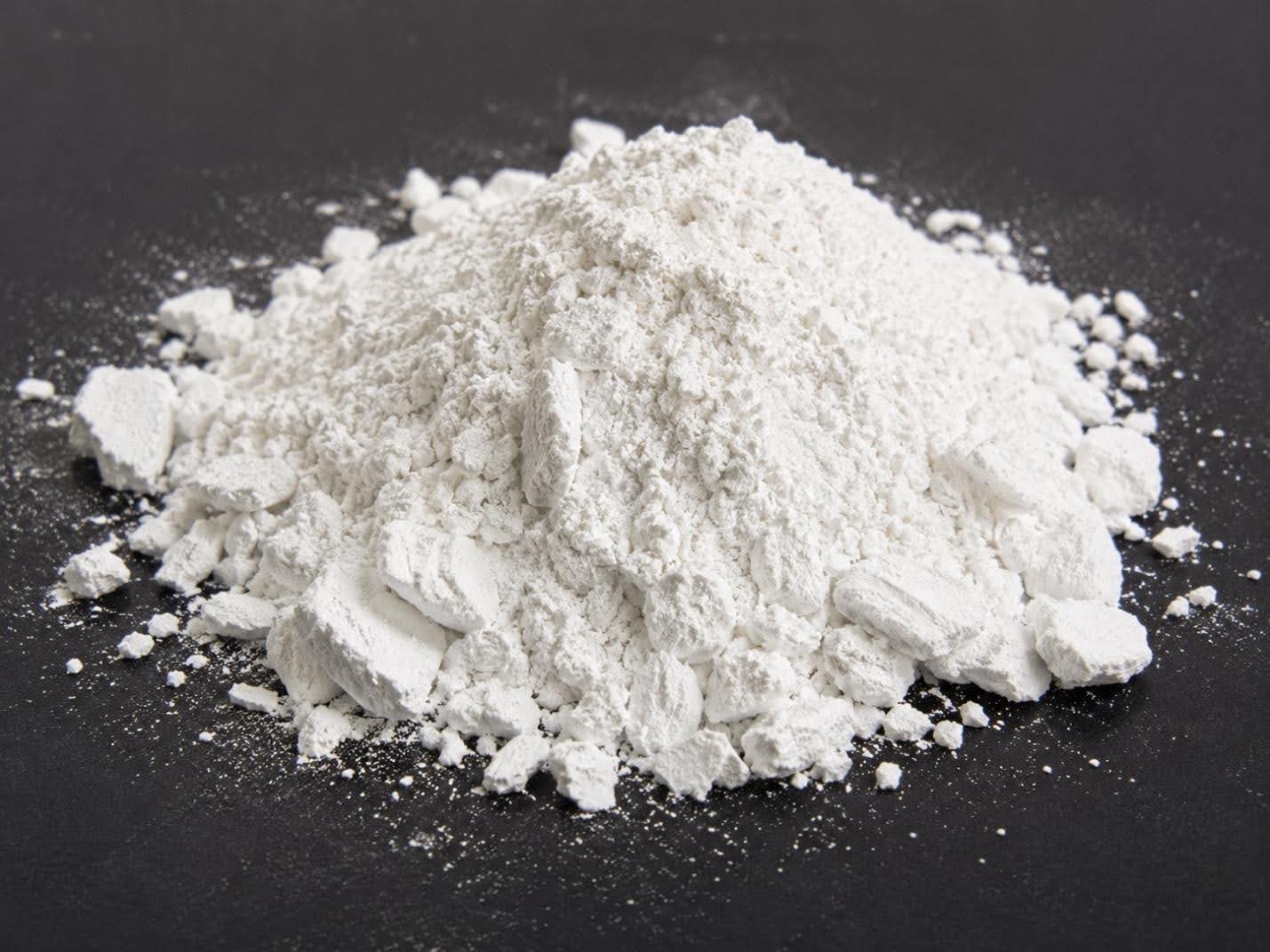
Micronized talc powder grades vary considerably depending on the application they’re intended for, and matching the right grade to the right use case is really the core decision buyers need to make. The table below summarizes typical mesh size, particle size (D97), and brightness across four common industrial uses.
|
Application |
Mesh size | D97 particle size | Brightness |
| Adhesives & sealants | 600-1500 mesh | 10-25 micron |
Brightness ≥92%, whiteness ≥95% |
|
Paints & coatings |
1250-3000 mesh | 5-10 micron | Brightness ≥94%, purity ≥96% |
| Automotive plastics (polycarbonates) | Ultra-fine grinding | ~8 micron |
High purity, high lamellarity for creep resistance |
|
General industrial plastics/PP |
Varies by grade | 1.7-10 micron (typical range) |
Grade-dependent |
These specifications vary by application and product grade. For a broader overview of the available categories and characteristics, read our guide to types of talc powder.
Why finer particle size matters
Finer, more uniform particle size improves dispersion within the base material, which leads to more consistent mechanical properties and a smoother surface finish in the final product. In paint and coating formulations, particle size can influence dispersion, opacity, and surface finish. For a closer look at these applications, see our guide to talc for paint. In plastics, finer grades support higher nucleation, which improves impact strength and stiffness, and support better creep resistance, meaning greater resistance to gradual deformation under sustained stress. That last point is particularly relevant for automotive and other structural plastic components that stay under load over long periods, where even small amounts of long-term deformation can affect fit and function. Across both paints and plastics, the underlying pattern is the same: finer, more consistent particles simply have more surface area and more contact points within the formulation, which is what drives the improvements in dispersion, opacity, and mechanical performance.
Talc’s lamellar structure and why it matters
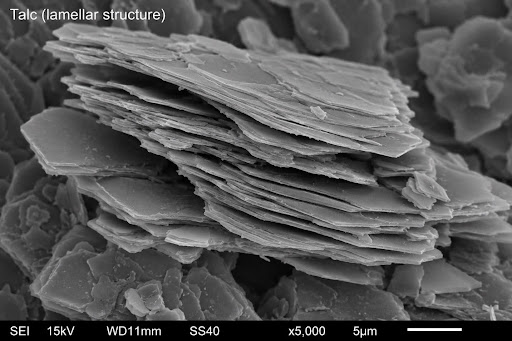
Talc’s naturally flat, plate-like, or lamellar, particle structure is what gives micronized talc powder its functional advantage over more rounded mineral fillers. In paints and coatings, this structure provides excellent rheological control, helping to suspend pigments and additives evenly throughout the formulation rather than letting them settle unevenly. In plastics, that same lamellar structure allows filled polymers to withstand more strain without deformation compared to unfilled polymers, or those filled with less lamellar minerals, since the flat particles reinforce the polymer matrix more effectively than rounded particles do. Talc also has naturally low thermal conductivity relative to some other fillers, though it can still perform well in specific thermal applications depending on the overall formulation. That combination of properties, lamellarity, softness, and chemical stability together, is part of why talc remains a preferred filler even where alternative minerals are available at a similar cost.
Grade selection for your application
There’s no single universally “best” micronized talc grade, only the right grade for a specific formulation, and that’s worth stating plainly rather than glossing over it. Buyers should specify their target application, whether that’s paint, plastics, adhesives, or something else, so the appropriate mesh and particle size grade can be recommended for that specific use case rather than a generic one.
Suited to your application
Narm Powder supplies industrial-grade micronized talc for applications ranging from adhesives and coatings to engineering plastics. For product specifications or to request a sample, visit our micronized talc powder product page.