
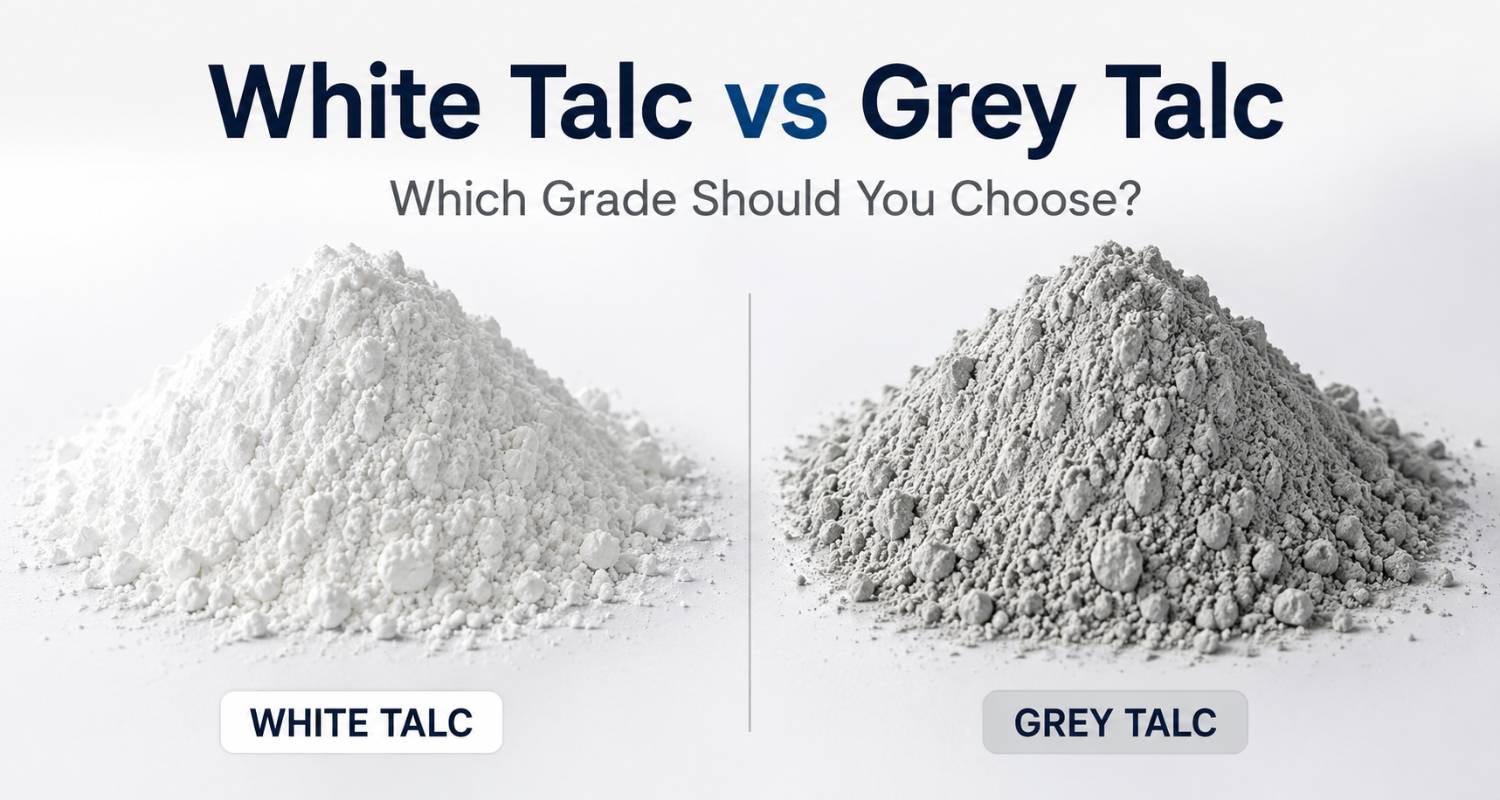
If you’re comparing white talc vs grey talc before placing an order, the decision comes down to three practical factors: whiteness, application, and budget. Neither grade is generically “better”. The right choice depends on what your end product actually requires. This guide walks through exactly how to make that call, so you can specify the right grade with confidence and avoid paying for brightness you don’t need, or under-specifying for an application that demands it.
White and grey talc are two color-based categories, but talc powders can also be classified by other characteristics, including grade, purity, and particle size. For a broader overview, see our guide to the types of talc powder.
Why White Talc and Grey Talc Look Different
The color difference between white talc and grey talc comes from the ore itself, not from how the powder is processed. Grey talc carries naturally occurring mineral impurities from its original deposit, mainly iron oxides, chlorite, and dolomite, which darken the powder. White talc comes from deposits with far fewer of these impurities, giving it higher magnesium silicate purity and noticeably higher brightness. In short, the color is a fact of geology, not a sign of how carefully the material was processed or refined. It’s also worth noting upfront that this difference is purely cosmetic: lubrication, chemical inertness, and thermal stability are identical across both grades.
White Talc vs Grey Talc: Specifications at a Glance
Before deciding between white talc and grey talc, it helps to see the numbers side by side. The table below compares brightness, purity, particle size, and relative cost. Scan it for the figures that matter to your order.
|
Specification |
White talc | Grey talc |
| GE Brightness / Whiteness | 85–96% |
70–85% |
|
MgO content (purity indicator) |
Higher (fewer impurities) | Lower (iron, chlorite, carbonates present) |
| Color source | High-purity magnesium silicate, minimal impurities |
Iron oxides, chlorite, dolomite, or other minerals naturally present |
|
Particle size range |
325–2500 mesh (all grades) | 200–800 mesh (typically coarser) |
| Density | 2.58–2.83 g/cm³ |
2.58–2.83 g/cm³ (similar) |
|
Relative cost |
Higher |
Lower |
Source: industry-standard specification ranges for white and grey talc powder.
As the table shows, the main differences are brightness and purity, while the functional properties remain essentially the same.
When to Choose White Talc
White talc is the right call whenever the color or brightness of your finished product matters to your customer or your brand. In the white talc vs grey talc comparison, this is the grade that protects appearance. It’s a strong fit for:
- Paints and coatings: whiteness directly affects the final color of the product, and white talc preserves brightness and opacity in the formulation.
- High-grade plastics: light-colored or white plastic parts need a filler that won’t darken the compound.
- Paper manufacturing: the brightness of the finished sheet depends partly on the brightness of the filler used.
- Ceramics: surface appearance and finish quality call for a high-brightness filler.
If your customer specifies a whiteness percentage, or your end product is light-colored, white talc is built for that job.
When to Choose Grey Talc
Grey talc isn’t a compromise. It’s the correct, cost-effective choice whenever color isn’t a performance factor. It works well for:
- Construction fillers and roofing compounds: the filler’s color is hidden in the final product, so purity is less critical.
- Lower-grade rubber and industrial seals: functional performance matters more than brightness.
- General industrial fillers: anywhere your customer hasn’t specified a whiteness requirement.
When color isn’t part of the spec, grey talc delivers the same functional performance at a more efficient cost. There’s no reason to pay for brightness your product doesn’t show. This is especially relevant for buyers running high-volume orders, where even small differences in material cost can become meaningful across a full shipment. In these cases, grey talc lets you maintain the functional properties that matter, such as inertness and density, while keeping material costs down, which is usually the bigger priority once color is off the table.
Decision Matrix: White Talc vs Grey Talc
If you’re still unsure, use this quick reference to match your situation to the right grade.
|
Your situation |
Choose white talc | Choose grey talc |
| End product color | Light-colored or white final product (paint, white plastic, paper) |
Color is not visible or not important in the final product |
|
Industry |
Paints & coatings, high-grade plastics, ceramics, paper | Construction fillers, roofing compounds, lower-grade rubber, general industrial |
| Whiteness requirement | GE brightness ≥ 90% required |
GE brightness 70–85% acceptable |
|
Budget sensitivity |
Higher cost acceptable for performance | Cost reduction is a priority over brightness |
| Buyer’s specification | Customer specifies whiteness % in their COA requirements |
No whiteness spec given by the customer |
Most buyers find they land clearly on one side of this table once they look at their own product spec and customer requirements. If your situation genuinely splits across both columns (for example, a mid-tone product where brightness is somewhat visible but not critical), that’s usually a sign to request samples of both white talc and grey talc and test them directly in your process rather than guessing from specs alone.
Beyond color and grade, industrial buyers may also need to compare talc with other mineral materials. Read our guide to talc vs graphite differences to understand how their properties and industrial applications differ.
Ready to Place Your Order?
Narm Powder supplies both white and grey talc powder across multiple grades. If you’re unsure which grade fits your application, request a sample of both and compare performance in your own process. There’s no substitute for testing the material in your own line.
Visit our talc powder product page to explore available product specifications, or contact our team on WhatsApp to discuss your requirements and request samples.